|
Florida Everglades
Everglades National Park
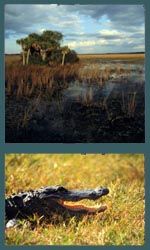
Everglades National Park lies at the southern tip of Florida. The Park’s 1.5-million acres contain many distinct ecosystems including sawgrass prairies, pinelands, hammocks, cypress swamps, mangroves, saltwater marshes and Florida Bay. The highest point in the Everglades is 8 feet above sea level. A gradual gradient makes for the southern movement of shallow waters toward the Gulf of Mexico.
Anhinga Trail
The 1/2-mile Anhinga loop Trail begins at a short paved area, which leads to an elevated boardwalk. The boardwalk winds through a sawgrass marsh and Taylor Slough, which resembles a pond in some areas. The word "slough" (pronounced "slew") is used to describe Everglades areas where there is slightly, deeper water than in the surrounding marshes and where a slow current is present.
Long Pine Key
Long Pine Key in Everglades National Park contains a pine forest community indicative of the original pine ("fire") forests of Florida. The forest contains slash pines with an understory of saw palmettos, wildflowers and ferns.
Plants that grow in the pinelands must be resistant to fire as areas such as these are maintained by fire. Fires are beneficial to the pines as young pine seedlings require lots of sunlight to survive, and the fires destroy hardwood competitors. When fires occur, hardwood seedlings and other understory plants are affected, while the thick bark of the pine resists fire damage. Without fires, hardwoods would eventually overshadow the pines and a hardwood hammock would emerge.
Pa-hay-okee Overlook Trail
The Pa-hay-okee (Indian word for "grassy waters") Overlook Trail consists of a short boardwalk trail, which ends at an observation tower. From the tower, visitors can take-in an incredible view of the endless grassy waters, which make up the "River of Grass", and a large cypress dome.
Mahogany Hammock
The 1/2-mile Mahogany Hammock boardwalk winds from sawgrass on lower ground into an elevated mahogany hammock.
South of the Mahogany Hammock Trail, freshwater marl prairie is seen along the east and west sides of the main park road. Freshwater marl prairie is a type of marsh that is flooded about 3 to 7 months a year. Large expanses of freshwater marl prairie are found within Everglades National Park.
Information provided by USGS - SOFIA - visit their website for photos and 360 degree virtual tours of the park.
|